DAIMONPROJECT DAIMON
Entities and mystical beings · tradition, folklore and historical occultism

DAIMON — critical dossier on mystical beings and folklore

A skeptical dossier on fairies, goblins, elves, djinn, angels and demons. What is an early source, what is late reconstruction, and what was invented yesterday and sold as immemorial.

The question guiding every entry: what here is actually attested?
scroll to open the file
14classified entries
7grades on the seal scale
6primary sources cited
10centuries covered, 12th to 21st

Classification scale

Every factual statement in this dossier carries a seal. The seal qualifies the documentary status of the statement, not the cultural value of the belief.

ATTESTED

Documented in a verifiable primary source or established by peer-reviewed scientific evidence.

EARLY SOURCE

Recorded in a text contemporary or close to the tradition described, with no evident later interpolation.

LATE SOURCE

Attested only in records far later than the period the belief is attributed to.

RECONSTRUCTION

A system assembled after the fact from fragments, syntheses or borrowings across distinct traditions.

MODERN INVENTION

Created in the 19th or 20th century and retro-projected onto traditions that never contained it.

FICTION

Authored narrative, confessed hoax or material with no documentary basis whatsoever.

PENDING CLAIM

Announcement or attribution without peer-reviewed publication or a critical edition backing it.

01

Demonological and Canonical Foundations

Analysis of medieval and modern theological treatises on demons and angels.

European demonology is not born of folklore: it is born of law. Between the 13th and 17th centuries, theologians and jurists turned a diffuse category of spirits into an object of doctrine, with defined nature, hierarchy, limits of power and — decisively — standards of proof usable in court. What these treatises contain is less supernatural zoology than jurisprudence.

The Malleus Maleficarum (1486) is the best-known case, but neither the only one nor the most influential everywhere: parts of the Inquisition itself rejected it and it coexisted with competing manuals. Its documentary importance is enormous; its doctrinal authority was already contested in the 16th century. Reading it as a portrait of universal period belief is anachronism.

Angelology follows a parallel path. The Hebrew prophetic descriptions — six-winged seraphim, eye-covered wheels — predate and are alien to the humanised angel that Christian art would consolidate. The nine-choir celestial hierarchy attributed to Pseudo-Dionysius is a late-antique systematisation, not a biblical text.

Demonological hierarchies in classical treatises

What each work actually organises — and with what documentary status.

WorkYearOrganising axisSeal
Malleus Maleficarum1486Organises the matter by judicial procedure, not by a catalogue of names.ATTESTED
Pseudomonarchia Daemonum1577Lists sixty-nine demons with noble titles and assigned legions.EARLY SOURCE
De praestigiis daemonum1563Johann Weyer turns demonology against the hunt: he attributes confessions to mental illness.ATTESTED
Daemonologie1597James VI codifies the doctrine in dialogue form, lending it royal authority.EARLY SOURCE
Lemegeton / Ars Goetiac. 1650A compilation of seventy-two spirits with graphic seals; a late manuscript of restricted circulation.LATE SOURCE
ATTESTED

The Malleus Maleficarum details the legal and theological nature of incubi and succubi.

Why
The 1486 treatise attributed to Heinrich Kramer discusses sexual demons within the scholastic and procedural framework of its time, including the problem of generation and of human culpability. Attesting that the text addresses the topic does not validate the entities: it validates the document and its doctrine.
How to check
Read Part I, Question 3 of the Malleus Maleficarum in an annotated critical edition.
ATTESTED

Familiar spirits appear as practical assistants in pacts described in witchcraft trials.

Why
Early modern judicial records, especially English ones, document testimony about animal-shaped familiars — cats, toads, mice — fed by the accused. What is attested is the testimony and the judicial procedure that produced it, often under coercive interrogation, not the described fact.
How to check
Consult transcripts of 17th-century English witch trials and the pamphlets of Matthew Hopkins.
EARLY SOURCE

Angels with six wings and many eyes have a basis in prophetic biblical texts.

Why
The visions of Isaiah and Ezekiel describe seraphim and cherubim with complex, non-human anatomies: six wings, wheels with eye-covered rims, multiple faces. The angel as a winged human youth is later iconography, late Christian and Renaissance.
How to check
Read Isaiah 6:2 and Ezekiel 1:15-21 in an annotated translation from the Hebrew.
LATE SOURCE

The demonic pact signed on a physical document is a proven medieval tradition.

Why
The written, signed contract takes shape chiefly in 17th-century trials — the Urbain Grandier case at Loudun produced a supposed pact written in reverse and signed by named demons. Medieval theology spoke of the pact mainly as tacit consent, not as a documentary artefact.
How to check
Study the Loudun trial records (1634) and the discussion of the tacit pact in Thomas Aquinas.
02

European Folklore and Liminal Entities

Fairies, gnomes and elves in oral tradition before Victorian romanticisation.

Before the 19th century, the beings of European folklore were not charming. They were dangerous, morally ambiguous and frequently adult-sized. The narratives deal with abduction, changelings, debt, dilated time and the prohibition on eating in the Otherworld — a repertoire of risk, not of delight.

Liminality is the structural key: these beings inhabit thresholds — doorsteps, crossroads, dusk, mounds, water margins. They are not "supernatural" in the modern sense but neighbours from an adjacent territory with its own rules, negotiated through etiquette, offering and silence.

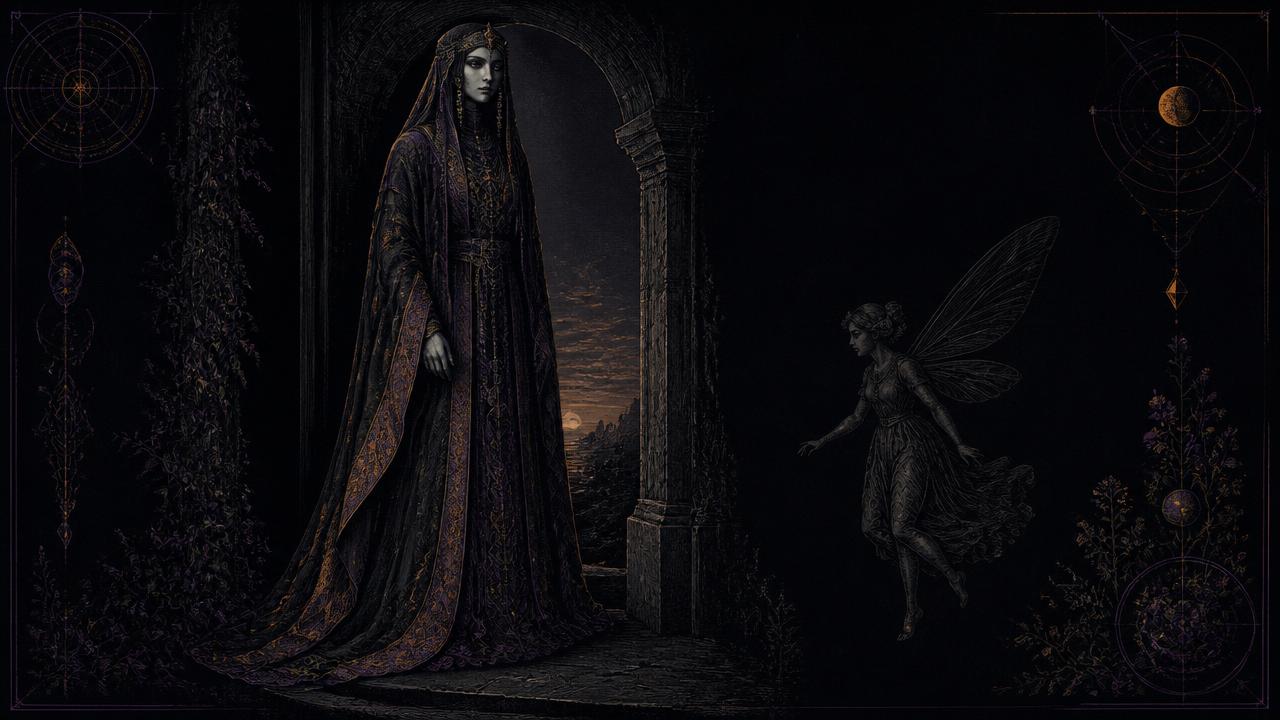
Domestication comes in three waves: Paracelsus's Renaissance learned classification, the Romantic collecting of the 18th and 19th centuries, and Victorian illustration fixing wings, tiny size and docility. Each wave erases part of the earlier material and is later read as if it were the original.

Comparison between the human-sized medieval Otherworld lady and the winged Victorian fairy.
Visual reconstruction · Otherworld lady (12th–14th c.) and winged fairy (19th c.)AI-generated image

Iconographic evolution of fairies

From the 12th to the 19th century: seven centuries of Otherworld lady, fifty years of winged miniature.

XII–XIIIOtherworld LadyHuman-sized, richly dressed, bound to pact and prohibition. Wingless.
XIV–XVTrial subjectAbsorbed into demonological vocabulary; begins to appear in judicial testimony.
XVIClassified elementalParacelsus orders nymphs, sylphs, gnomes and salamanders by element.
XVII–XVIIICourt taleFrench salons turn the material into literature of morals and etiquette.
XIXWinged miniatureVictorian illustration fixes insect wings, tiny scale and childlike docility.
MODERN INVENTION

Fairies have butterfly wings in medieval folkloric accounts.

Why
In medieval tradition fairies are described as human-sized, richly dressed and wingless — Otherworld ladies, not anthropomorphic insects. The winged, diminutive iconography is a creation of 19th-century British illustration, consolidated by Victorian engravers and watercolourists and later industrialised in children's books.
How to check
Compare medieval lais (Marie de France, Sir Orfeo) with English folkloric illustration of the 18th and 19th centuries.
EARLY SOURCE

Gnomes were catalogued as earth elementals by Paracelsus in the 16th century.

Why
In Liber de Nymphis, Sylvanis, Pygmaeis et Salamandris Paracelsus organises four classes of beings tied to the elements — nymphs to water, sylphs to air, pygmies/gnomes to earth, salamanders to fire. The scheme is a Renaissance learned classification, not a record of oral folklore.
How to check
Consult the Liber de Nymphis, published posthumously in 1566.
MODERN INVENTION

The elves of original Norse mythology were small, benevolent beings in red hats.

Why
The álfar of Norse sources appear associated with the gods and with their own sacrifices, with no indication of diminutive size or colourful clothing. The red-hatted garden gnome is a 19th-century product, between Scandinavian illustration and German ceramic manufacture.
How to check
Consult Snorri Sturluson's Prose Edda and the eddic poems mentioning the álfablót.
LATE SOURCE

Leprechauns guard pots of gold at the rainbow's end in ancient Celtic mythology.

Why
The leprechaun appears in Irish sources as a solitary shoemaker linked to hidden coins; the pot-at-the-rainbow's-end formula consolidates in romanticised 19th-century folklore and 20th-century postcard industry. There is no basis in the ancient mythological cycles.
How to check
Examine T. Crofton Croker's Fairy Legends and Traditions of the South of Ireland (1825).
03

Djinn and Eastern Traditions

Pre-Islamic and Qur'anic sources on the djinn and their classification.

Jinn are not demons in the Christian sense. In the sources they are a third order of creatures endowed with free will, mortality and moral responsibility — able to believe or disbelieve. This structural difference is the most common translation error when European demonological vocabulary is applied to Arabic material.

Pre-Islamic poetry already ties them to the desert, to uninhabited places and to the poet's inspiration. Qur'anic cosmology defines them by their created matter — scorching fire, distinct from human clay — and later literature adds taxonomies (marid, ifrit, ghul) that do not share the same textual status.

The lamp genie is an exemplary case of displacement: the figure popularised in the West derives from 18th- and 19th-century European translations and additions to the Thousand and One Nights, not from classical cosmology.

EARLY SOURCE

Djinn are described as beings created from smokeless fire in classical Arabic texts.

Why
The Qur'anic text states that djinn were created from scorching fire, and pre-Islamic poetry already recorded the jinn as desert dwellers tied to wild places and poetic inspiration. This is an old cosmological category, prior to later theological systematisation.
How to check
Check Surah Al-Hijr (15:27) and Ar-Rahman (55:15), plus compilations of pre-Islamic poetry (Mu'allaqat).
04

Encantados and Popular Spirituality

The construction of protective entities in folk imagination and their variations.

Portuguese-language folk material offers the best available laboratory for observing syncretism in documented formation. Saci, Curupira, Boitatá and Iara are not pure survivals of any single matrix: they are composites, and the layers remain visible when colonial records, 19th-century collecting and 20th-century literary fixation are compared.

The Curupira already appears in 16th-century Jesuit letters as a hunting-protector entity punishing excess — an ecological regulating function, not Christian morality. The Boitatá is recorded as a fire crossing fields, a description compatible with gas combustion in marshy ground, though that does not exhaust the narrative.

The Encantados in popular religiosity operate as a mediating category: beings who did not die but became enchanted, occupying a position between living and dead. The critical point is that the canonical image of each of these entities was stabilised by literate mediators — the fixation is traceable and datable.

RECONSTRUCTION

The Saci-pererê is purely European in origin, brought by colonisers.

Why
The figure results from layers: an Indigenous core of a whistling forest entity that misleads travellers, African attributes absorbed through the colonial period, and European trickster and whirlwind motifs. The canonical image — one-legged, red cap, pipe — is literary and early 20th-century.
How to check
Consult Luís da Câmara Cascudo's comparative mythology and Monteiro Lobato's 1917 survey.
05

Theosophical and Victorian Reconstructions

The visual and conceptual transformation of mystical beings in the 19th century.

The 19th century is when folkloric material stops being transmitted and starts being produced. Three forces converge: the illustrated publishing industry, parlour spiritualism and scholarly orientalism. The result is a new body of "tradition" with known authorship and precise dating, sold as immemorial wisdom.

The Theosophical Society, founded in 1875, is the most efficient vector: it imports Sanskrit vocabulary, merges it with Paracelsian elementalism and returns a hierarchical deva system with colour, function and evolutionary grade. None of this exists in the traditions invoked as source.

The Cottingley episode closes the cycle with almost didactic precision: photographs of paper cut-outs, defended by a famous author during collective post-war mourning, functioning as evidence for sixty years. The 1983 confession did not undo the image — by then the image had become the visual reference for the very concept of a fairy.

FICTION

The 1917 Cottingley Fairies photographs recorded real beings.

Why
The five photographs were made with paper cut-outs fixed by hatpins. In 1983 Elsie Wright and Frances Griffiths publicly admitted the hoax. The case gained traction because Arthur Conan Doyle defended it in 1920, amid a post-war surge of spiritualism.
How to check
Examine the 1983 statements by Elsie Wright and Frances Griffiths and Conan Doyle's article in The Strand Magazine (1920).
RECONSTRUCTION

Theosophy established a systematic hierarchy of devas and nature spirits.

Why
H. P. Blavatsky and C. W. Leadbeater combined Sanskrit vocabulary, Paracelsian elementalism and European folklore into a new system with degrees, colours and functions. The result is a 19th- and early 20th-century construction presented as recovered ancient knowledge.
How to check
Check The Secret Doctrine (1888) and Geoffrey Hodson's The Kingdom of the Gods (1952).
06

Neurobiology and Phenomenology of Visions

Cognitive and physiological models for reported encounters with entities.

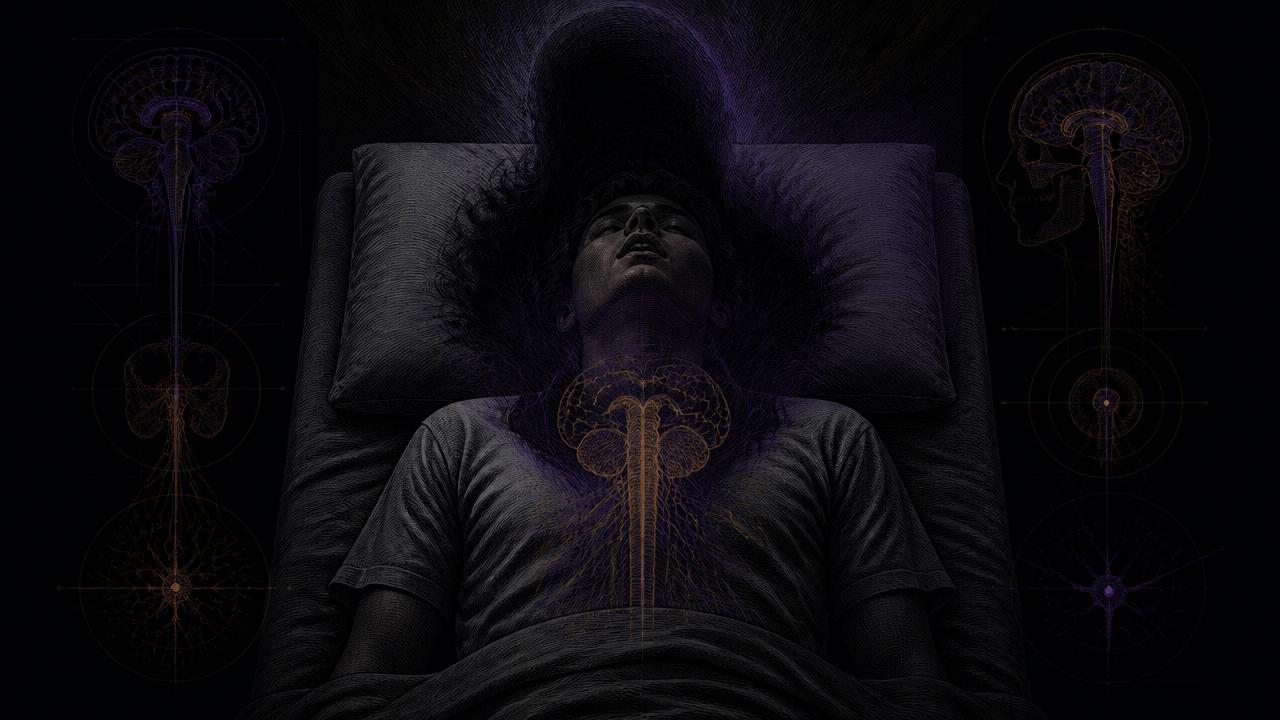
Reports of entity encounters show cross-cultural regularities too strong to be merely cultural. The recurring nocturnal episode of immobility, sensed presence and chest pressure points to a physiological substrate: isolated sleep paralysis, with REM atonia intruding into wakefulness.

Other documented mechanisms: the "sensed presence" produced by temporoparietal dysfunction, complex visual hallucinations under sensory deficit (Charles Bonnet syndrome), facial pareidolia, sleep deprivation and expectancy effects. None requires an external entity; all produce subjectively undeniable experience.

Explaining the mechanism is not accusing the reporter of lying. The experience is real as experience; what analysis refuses is the leap from phenomenology to ontology — from "I felt a presence" to "there was an entity". Culture supplies the name, the face and the intent attributed to what physiology produced.

Diagram of a sleep paralysis episode with a perceived presence over the chest.
Didactic diagram · REM atonia during wakefulness and perceived presenceAI-generated image

Neurobiology of sleep paralysis

The physiological sequence that produces the nocturnal encounter with an oppressive presence.

01

Persistent REM atonia

REM motor inhibition stays active as consciousness returns: the body remains immobile.

02

Dream imagery while awake

Hypnagogic or hypnopompic content overlays perception of the actual room.

03

Hyperactive agency detection

Under threat and immobility, the brain assigns intent to ambiguous noise: the presence is born.

04

Chest pressure

Shallow breathing and involuntary diaphragm control generate the sensation of weight on the chest.

05

Cultural naming

The available repertoire supplies the face: incubus, mara, pisadeira, djinn, grey entity.

ATTESTED

Sleep paralysis explains encounters with oppressive nocturnal entities.

Why
REM muscular atonia persisting into wakefulness, together with hypnagogic and hypnopompic hallucinations, produces the recurring triad: immobility, sensed presence and chest pressure. The phenomenon is reproducible in the laboratory and reported worldwide, with variable cultural clothing — incubus, mara, pisadeira.
How to check
Review the sleep-neurology literature on isolated sleep paralysis and presence hallucinations.
FICTION

Poltergeist phenomena are caused exclusively by demons, according to modern science.

Why
No scientific body supports that attribution. Documented investigations point to hoaxing — often by adolescents in the household —, misread structural noise, draughts, infrasound, family tension and suggestion effects. The Enfield case, the basis of film franchises, involved pranks admitted by the children themselves.
How to check
Consult Society for Psychical Research investigation reports and the psychological literature on suggestion.
07

Invented later, sold as ancient

Elements that today pass as immemorial tradition and have known authorship, date and circulation.

DatingElementWhat the record shows
19th centuryButterfly wings on fairiesAbsent from the whole medieval tradition; introduced by British illustration and later retro-projected onto old accounts.
19th centuryRed hat and tiny stature of elvesNorse álfar have neither defined size nor described clothing; the garden gnome is a 19th-century manufacture.
19th–20th centuryPot of gold at the rainbow's endA formula of romanticised folklore and print industry, with no basis in the ancient mythological cycles.
17th centuryDemonic pact as a signed documentA modern trial artefact; medieval theology treated the pact chiefly as tacit consent.
1875–1925Theosophical hierarchy of devasAn authored synthesis of Eastern vocabulary with European elementalism, presented as recovered tradition.
1917–1983The Cottingley Fairies as evidencePaper cut-outs fixed with hatpins; a hoax confessed by the authors six decades later.
08

Entries and seals

Full index of the statements analysed. Filter by seal to see what supports each grade.

MODERN INVENTION

Fairies have butterfly wings in medieval folkloric accounts.

Why
In medieval tradition fairies are described as human-sized, richly dressed and wingless — Otherworld ladies, not anthropomorphic insects. The winged, diminutive iconography is a creation of 19th-century British illustration, consolidated by Victorian engravers and watercolourists and later industrialised in children's books.
How to check
Compare medieval lais (Marie de France, Sir Orfeo) with English folkloric illustration of the 18th and 19th centuries.
FICTION

The 1917 Cottingley Fairies photographs recorded real beings.

Why
The five photographs were made with paper cut-outs fixed by hatpins. In 1983 Elsie Wright and Frances Griffiths publicly admitted the hoax. The case gained traction because Arthur Conan Doyle defended it in 1920, amid a post-war surge of spiritualism.
How to check
Examine the 1983 statements by Elsie Wright and Frances Griffiths and Conan Doyle's article in The Strand Magazine (1920).
EARLY SOURCE

Djinn are described as beings created from smokeless fire in classical Arabic texts.

Why
The Qur'anic text states that djinn were created from scorching fire, and pre-Islamic poetry already recorded the jinn as desert dwellers tied to wild places and poetic inspiration. This is an old cosmological category, prior to later theological systematisation.
How to check
Check Surah Al-Hijr (15:27) and Ar-Rahman (55:15), plus compilations of pre-Islamic poetry (Mu'allaqat).
ATTESTED

The Malleus Maleficarum details the legal and theological nature of incubi and succubi.

Why
The 1486 treatise attributed to Heinrich Kramer discusses sexual demons within the scholastic and procedural framework of its time, including the problem of generation and of human culpability. Attesting that the text addresses the topic does not validate the entities: it validates the document and its doctrine.
How to check
Read Part I, Question 3 of the Malleus Maleficarum in an annotated critical edition.
EARLY SOURCE

Gnomes were catalogued as earth elementals by Paracelsus in the 16th century.

Why
In Liber de Nymphis, Sylvanis, Pygmaeis et Salamandris Paracelsus organises four classes of beings tied to the elements — nymphs to water, sylphs to air, pygmies/gnomes to earth, salamanders to fire. The scheme is a Renaissance learned classification, not a record of oral folklore.
How to check
Consult the Liber de Nymphis, published posthumously in 1566.
ATTESTED

Familiar spirits appear as practical assistants in pacts described in witchcraft trials.

Why
Early modern judicial records, especially English ones, document testimony about animal-shaped familiars — cats, toads, mice — fed by the accused. What is attested is the testimony and the judicial procedure that produced it, often under coercive interrogation, not the described fact.
How to check
Consult transcripts of 17th-century English witch trials and the pamphlets of Matthew Hopkins.
EARLY SOURCE

Angels with six wings and many eyes have a basis in prophetic biblical texts.

Why
The visions of Isaiah and Ezekiel describe seraphim and cherubim with complex, non-human anatomies: six wings, wheels with eye-covered rims, multiple faces. The angel as a winged human youth is later iconography, late Christian and Renaissance.
How to check
Read Isaiah 6:2 and Ezekiel 1:15-21 in an annotated translation from the Hebrew.
MODERN INVENTION

The elves of original Norse mythology were small, benevolent beings in red hats.

Why
The álfar of Norse sources appear associated with the gods and with their own sacrifices, with no indication of diminutive size or colourful clothing. The red-hatted garden gnome is a 19th-century product, between Scandinavian illustration and German ceramic manufacture.
How to check
Consult Snorri Sturluson's Prose Edda and the eddic poems mentioning the álfablót.
RECONSTRUCTION

Theosophy established a systematic hierarchy of devas and nature spirits.

Why
H. P. Blavatsky and C. W. Leadbeater combined Sanskrit vocabulary, Paracelsian elementalism and European folklore into a new system with degrees, colours and functions. The result is a 19th- and early 20th-century construction presented as recovered ancient knowledge.
How to check
Check The Secret Doctrine (1888) and Geoffrey Hodson's The Kingdom of the Gods (1952).
ATTESTED

Sleep paralysis explains encounters with oppressive nocturnal entities.

Why
REM muscular atonia persisting into wakefulness, together with hypnagogic and hypnopompic hallucinations, produces the recurring triad: immobility, sensed presence and chest pressure. The phenomenon is reproducible in the laboratory and reported worldwide, with variable cultural clothing — incubus, mara, pisadeira.
How to check
Review the sleep-neurology literature on isolated sleep paralysis and presence hallucinations.
LATE SOURCE

Leprechauns guard pots of gold at the rainbow's end in ancient Celtic mythology.

Why
The leprechaun appears in Irish sources as a solitary shoemaker linked to hidden coins; the pot-at-the-rainbow's-end formula consolidates in romanticised 19th-century folklore and 20th-century postcard industry. There is no basis in the ancient mythological cycles.
How to check
Examine T. Crofton Croker's Fairy Legends and Traditions of the South of Ireland (1825).
RECONSTRUCTION

The Saci-pererê is purely European in origin, brought by colonisers.

Why
The figure results from layers: an Indigenous core of a whistling forest entity that misleads travellers, African attributes absorbed through the colonial period, and European trickster and whirlwind motifs. The canonical image — one-legged, red cap, pipe — is literary and early 20th-century.
How to check
Consult Luís da Câmara Cascudo's comparative mythology and Monteiro Lobato's 1917 survey.
LATE SOURCE

The demonic pact signed on a physical document is a proven medieval tradition.

Why
The written, signed contract takes shape chiefly in 17th-century trials — the Urbain Grandier case at Loudun produced a supposed pact written in reverse and signed by named demons. Medieval theology spoke of the pact mainly as tacit consent, not as a documentary artefact.
How to check
Study the Loudun trial records (1634) and the discussion of the tacit pact in Thomas Aquinas.
FICTION

Poltergeist phenomena are caused exclusively by demons, according to modern science.

Why
No scientific body supports that attribution. Documented investigations point to hoaxing — often by adolescents in the household —, misread structural noise, draughts, infrasound, family tension and suggestion effects. The Enfield case, the basis of film franchises, involved pranks admitted by the children themselves.
How to check
Consult Society for Psychical Research investigation reports and the psychological literature on suggestion.
09

Primary sources

Consultable documents underpinning the entries in this dossier.

Malleus Maleficarum (1486)

A procedural manual on witchcraft and demons; basis for the incubi, succubi and pact entries.

Liber de Nymphis (1566)

Paracelsus's treatise coining the elemental classification of gnomes, nymphs, sylphs and salamanders.

Daemonologie (1597)

James VI's dialogue giving royal form to British demonological doctrine.

Al-Qur'an — passagens sobre jinn

Surah Al-Hijr and Ar-Rahman: created matter and moral status of the djinn.

Compêndios de feitiçaria e registros de julgamentos

Trial transcripts and pamphlets documenting testimony on familiars and pacts.

Fairy Legends (1825) · Prose Edda

Folkloric collections and Norse sources used to date the romanticisation of these figures.

Interpretive pitfalls

Recurring errors that turn a document into proof of existence.

  • Anachronism: projecting Victorian concepts — wings, miniature scale, docility — onto medieval myths.
  • Accepting photographic forgery as historical evidence, even after public confession.
  • Confusing theological allegory with factual report: a treatise describes doctrine, not observation.
  • Taking testimony obtained under judicial coercion as spontaneous evidence of popular belief.
  • Translating one tradition's categories with another's terms — jinn as demon, deva as angel.
10

Pop culture as perception

These works explain what audiences expect to find. None of them is evidence of anything.

O Senhor dos Anéis

Fixed the tall, immortal, noble elf as the global standard. A coherent literary invention, not a survival of the Norse álfar.

Supernatural

Reprocessed urban folklore and demonology into a serialised bestiary whose internal rules are mistaken for tradition.

Franquia Invocação do Mal

Spectacularised real investigation cases, inverting the burden of proof: the film came to be cited as the case's source.

11

Questions the public asks

Short answers, each with its documentary criterion made explicit.

What is the historical origin of the concepts of invisible beings?

There is no single origin. The oldest traceable categories arise from three independent sources that later intersect: place and ancestor spirits in ancient religions, daimones as intermediaries in Greek philosophy, and Hebrew angelology of messengers. Later European vocabulary is an amalgam of these three lineages, reorganised by Christian theology between the 4th and 13th centuries.

How did Theosophy and the Victorian era redefine the look of fairies?

Through three operations: commercial illustration gave insect wings and tiny scale to figures tradition described as human-sized; children's literature removed the danger; and Theosophy supplied a hierarchical system with Sanskrit names lending the whole an air of antiquity. In fifty years, a new iconography replaced seven centuries of textual description.

Which neurobiological explanations account for entity visions?

The best established are isolated sleep paralysis, hypnagogic and hypnopompic hallucinations, sensed presence from temporoparietal dysfunction, complex visual hallucinations under sensory loss, and pareidolia. All produce vivid, memorable experience with no external agent, and all vary in content according to the subject's cultural repertoire.

Is there any entity report that withstands documentary analysis?

The documents withstand it; the entities do not. There are authentic trials, dated treatises, recorded testimony and reproducible clinical episodes — all solid material. No known case offers verifiable physical evidence of a non-human being. The distinction between "the record is real" and "what was recorded happened" is this dossier's axis.

Why does the same kind of encounter appear in cultures with no contact?

Because the substrate is physiological and the clothing is cultural. Sleep architecture, the agency-detection system and the limits of low-light perception are the same across the species. What changes is the name given to the presence — and that variation, far from weakening the natural explanation, is exactly what it predicts.

What does Portuguese-language folklore add to the overall picture?

It adds the rare chance to see syncretism in process with documentation. 16th-century Jesuit letters, 19th-century collecting and early 20th-century literary fixation allow each layer of figures like Saci and Curupira to be dated. In much European material those stages were lost and only the final version survives.

12

E-book

This site is the compact, free version. The e-book is the expanded version, with full notes and bibliography.

110 pages · 6 chapters

Liminal Beings: A Historical and Critical Dossier on Folklore and Demonology

Seres Liminares: Dossiê Histórico e Crítico sobre Entidades do Folclore e da Demonologia

A philological, anthropological and neurobiological analysis of belief in invisible beings.

01Constructing the Invisible: Theological and Mythological OriginsHistorical mapping of how entities emerge in ancient thought.18 pp.
02Demonology and Canon Law in the Middle AgesA study of treatises and trials involving pacts and obsessions.22 pp.
03From Threatening Creature to Winged Being: The Victorian TurnHow the 19th century redefined the look and role of fairies and gnomes.20 pp.
04Djinn and Near Eastern EntitiesAnalysis of Islamic and pre-Islamic cosmology concerning beings of fire.16 pp.
05Neurobiology of the Encounter: Hallucinations, Paralysis and IllusionsNeuroscientific explanation for reports of visions and presences.18 pp.
06Documentary Analysis of Forgeries and Modern MythsCase studies such as the Cottingley Fairies and mediumistic frauds.16 pp.
See the full dossierSee the full dossier
13

Origin and method

The name

DAIMON comes from the Greek δαίμων: in Antiquity, an intermediary spirit between gods and mortals — neither full deity nor human. Christianisation turned the term into "demon", and later vocabulary conflated it with genies, fairies and other beings of folklore. That breadth is what the name carries here: fairies, gnomes, goblins, elves, angels, demons and djinn all fit under one word because history itself put them there.

Methodology

Each statement is classified by documentary status, not by subjective plausibility. Primary sources take precedence over commentary; critical editions over freely circulating translations; peer-reviewed literature over popularisation. When sources diverge, the divergence is stated rather than resolved by preference. No practice is recommended, prescribed or assessed for efficacy: the object is the historical record, not anyone's devotional experience.

Transparency on AI use

Artificial intelligence tools were used in writing, translating and laying out this material, under human review of content and sources. AI-generated illustrations appear only when the object cannot be photographed, and carry a visible label at every occurrence. No generated image is presented as a historical document.